Decoding Venue Familiarity Patterns Across Equine Competitions, Team Encounters, and Individual Matches
Anna Beck · Jul 19, 2026
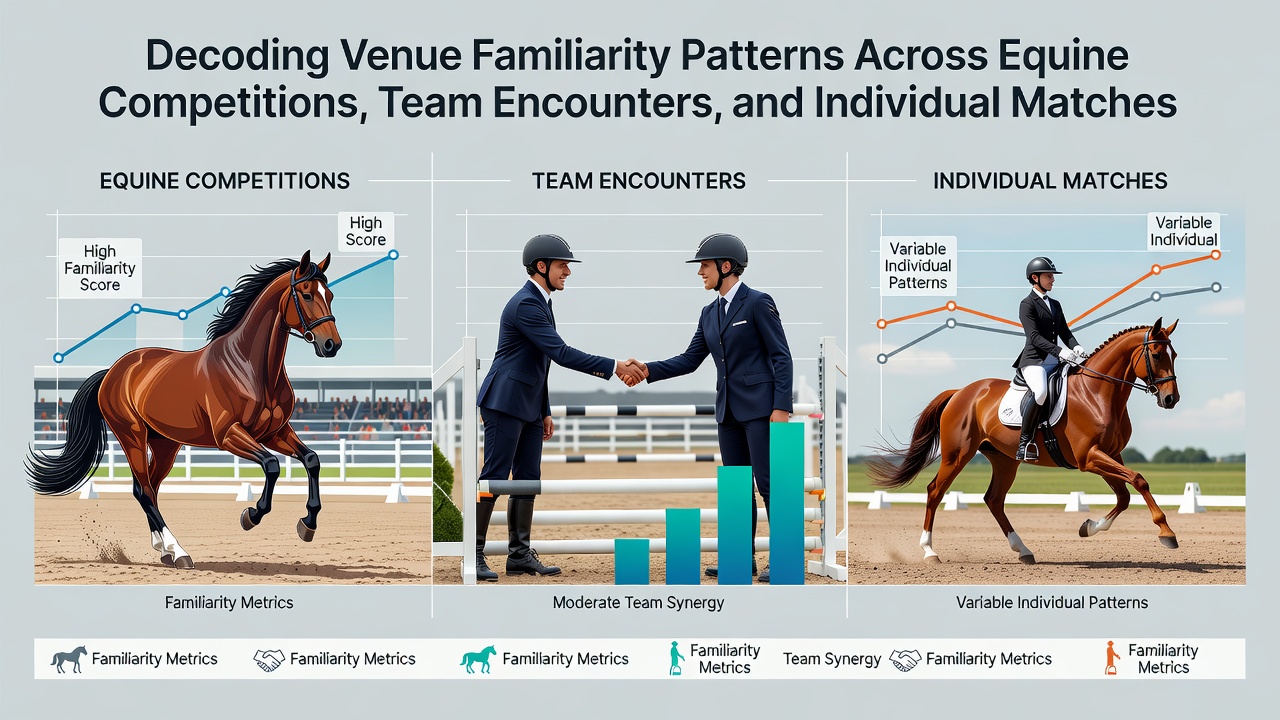
Decoding Venue Familiarity Patterns Across Equine Competitions, Team Encounters, and Individual Matches
Venue familiarity patterns emerge when competitors return to locations where they have prior experience, and data from multiple sports reveals measurable differences in outcomes tied to that history. Researchers tracking equine events have noted that horses running at tracks they have visited before often record adjusted times that differ from their performances at new venues, with records from flat and jump meetings illustrating these trends across seasons.
Equine Competitions and Track-Specific Adjustments
Horses demonstrate shifts in stride patterns and recovery rates when racing at familiar circuits, and studies compiled by organizations such as the Jockey Club show how surface consistency and layout memory influence positioning during the final furlongs. In July 2026, several major summer festivals highlighted these patterns as trainers selected runners with prior starts at the same courses, producing fields where repeat visitors occupied a higher share of leading positions in early betting markets.
Observers note that variables including rail position, camber, and prevailing wind directions interact with familiarity, yet the core effect remains visible when comparing debut runs against subsequent appearances at the same location. Records from Australian and North American tracks further indicate that horses with multiple prior outings at a venue maintain steadier sectional splits through the middle stages of races.
Team Encounters in Shared Facilities
Team sports display parallel trends when squads return to arenas or stadiums they have used repeatedly. Performance metrics collected across basketball leagues and football divisions show elevated shooting percentages or pass completion rates for sides playing at their established home grounds compared with neutral or away settings. Data aggregated by the National Collegiate Athletic Association indicates that venue-specific factors such as lighting angles, crowd proximity, and court dimensions contribute to these measurable edges.
During the opening weeks of July 2026, several international tournaments scheduled matches in venues that hosted earlier rounds, allowing teams additional preparation time based on prior exposure. Analysts reviewing match logs found that defensive organization improved among clubs with at least two previous visits to the same pitch, while turnover rates declined in line with accumulated familiarity.
Individual Matches and Court or Arena Memory

Tennis players exhibit distinct movement efficiencies on surfaces they have competed on before, and statistics maintained by the International Tennis Federation reveal higher first-serve percentages and fewer unforced errors when matches occur at previously used sites. The same principle applies in combat sports and athletics, where competitors who train or compete regularly at a given facility record tighter groupings in technical scoring categories.
One longitudinal review of Grand Slam qualifying data demonstrated that players advancing through multiple rounds at a single venue maintained rally lengths closer to their seasonal averages, whereas those switching locations mid-tournament showed greater variance in point duration. In July 2026, several challenger-level events took place at facilities that also hosted main-tour stops earlier in the calendar, creating opportunities to compare familiarity effects within the same fortnight.
Cross-Sport Comparisons and Data Integration
Patterns observed in equine, team, and individual disciplines share common threads when examined through standardized performance indicators. Researchers at institutions including the University of Queensland have examined how repeated exposure reduces cognitive load during high-pressure moments, resulting in more consistent execution across different activity types. Figures released by the Australian Sports Commission document similar directional shifts in both racing and court-based sports when competitors accumulate venue-specific starts.
These integrated datasets allow analysts to isolate the contribution of familiarity from other variables such as fitness levels or weather conditions. Records spanning multiple continents confirm that the magnitude of the effect scales with the number of prior visits, although the rate of improvement plateaus after a certain threshold of exposure.
Conclusion
Venue familiarity continues to register as a quantifiable factor in equine competitions, team encounters, and individual matches, supported by performance records maintained by governing bodies and academic research groups. Continued collection of sectional and situational data through 2026 and beyond will refine understanding of how layout memory, surface consistency, and environmental repetition combine to shape competitive outcomes across disciplines.